For years, it felt like women with natural curls couldn’t catch a break. Runways, red carpets, and magazine covers were dominated by sleek, straight styles—leaving curls, coils, and waves underrepresented. Thankfully, those days are behind us.
Today, natural texture is celebrated, embraced, and proudly worn by celebrities and everyday curl lovers alike. From loose waves to tight coils, curly hair is finally getting the recognition it deserves.
If you’ve ever wondered whether you should use curl cream, gel, or mousse—or struggled to understand why your curls behave differently from someone else’s—this guide breaks it all down. With expert insight from curl specialist Paola Torres of Utopia Hair and Day Spa in New Jersey, we’ll help you understand your curl type, porosity, and how to style your hair for its healthiest, most defined look.
Famous Faces Embracing Natural Curls
Natural curls are having a major moment. Supermodel Naomi Campbell recently graced the cover of British Vogue wearing her curls proudly. Beyoncé frequently showcases her natural texture, while Lupita Nyong’o stuns on red carpets with her 4C coils. Add Mariah Carey’s signature spiral curls and Yara Shahidi’s coily, playful styles, and it’s clear: curls are powerful, glamorous, and here to stay.
If they’re embracing their texture, so should you.
Understand Your Curls—Don’t Change Them
“Curly hair differs from other textures in a major way,” says Torres. For decades, many people felt pressured to relax or straighten their curls instead of learning how to care for them. But that mindset is shifting.
“In the past couple of years, I’ve seen so many people not only gain confidence, but also motivation to transition back to their natural curls,” Torres explains.
The first step? Understanding your curl pattern instead of fighting it.
Know Your Curl Type
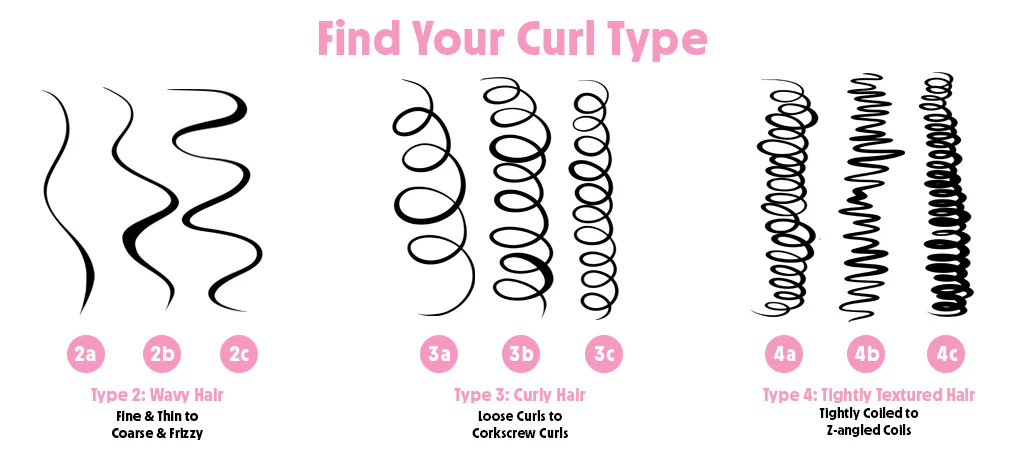
Curl types are classified on a scale from Type 2 to Type 4, with subcategories A through C. The lower the letter, the looser the curl.
Type 2: Wavy Hair
-
2A, 2B, 2C
-
Loose waves forming an “S” shape
-
Can range from fine and subtle to thicker, more defined waves
Type 3: Curly Hair
-
3A, 3B, 3C
-
Defined ringlets or tighter “S” curls
-
Often springy and voluminous
Type 4: Coily or Kinky Hair
-
4A, 4B, 4C
-
Tight coils or zigzag patterns
-
Shrinkage is common, texture is dense
And yes—having multiple curl patterns on one head is completely normal.
Why the Curl Chart Isn’t One-Size-Fits-All
No two heads of curly hair are exactly alike. According to Torres, “Your hair is unique to you, and knowing what your hair needs is key.”
Curly hair often requires experimentation. It’s normal to go through trial and error before finding the right routine. The goal is moisture, definition, and balance.
Understand Your Hair Porosity
Porosity refers to your hair’s ability to absorb and retain moisture—and it plays a huge role in frizz, dryness, and product performance.
High Porosity
-
Absorbs moisture easily but loses it quickly
-
Prone to frizz and dryness
Medium Porosity
-
Absorbs and retains moisture well
-
Generally easiest to manage
Low Porosity
-
Resists moisture absorption
-
Holds onto moisture once absorbed
Once you identify your porosity, choose products accordingly and take your time when styling.
“You don’t rush when styling curly hair,” Torres says. “Section by section is key for definition and avoiding product overload.”
Consistency Is the Secret to Great Curls
Unlike other hair textures that may benefit from switching products often, curly hair thrives on routine.
“When you find what works, stick to it,” Torres explains. “Consistent routines give consistent results.”
Quick Styling Tips for Defined Curls
-
Use a diffuser to enhance curl definition and volume
-
Scrunch hair in small sections to encourage curl formation
-
Air-dry curls by gently twisting or rolling individual strands
-
Ponytails and updos look stunning with curls—leave a few pieces loose for softness
Don’t Skip Clarifying
Product buildup can make curls look dull or lifeless. Torres recommends clarifying at least once a month.
“Many people think products stop working, but really their hair just needs a clean slate,” she explains.
Look for formulas that are:
-
Sulfate surfactant–free
-
Paraben-free
-
Silicone-free
A clean scalp is essential for healthy curls.
Curl-Friendly Products That Work for All Curl Types
When it comes to styling, the right products make all the difference. Look for lightweight hydration, frizz control, and buildable hold.
Key product types to include:
-
Leave-in conditioners for moisture and detangling
-
Curl creams for definition and softness
-
Gels for hold and frizz control
-
Mousses for volume and lightweight structure
-
Scalp oils or treatments for nourishment
Remember: start with small amounts and build as needed.
Start Your Curl Journey With Confidence
Curly hair doesn’t need to be tamed—it needs to be understood. Once you know your curl type, porosity, and ideal routine, your natural texture becomes your greatest asset.
Celebrate your curls, be patient with the process, and let your hair do what it does best—shine naturally.